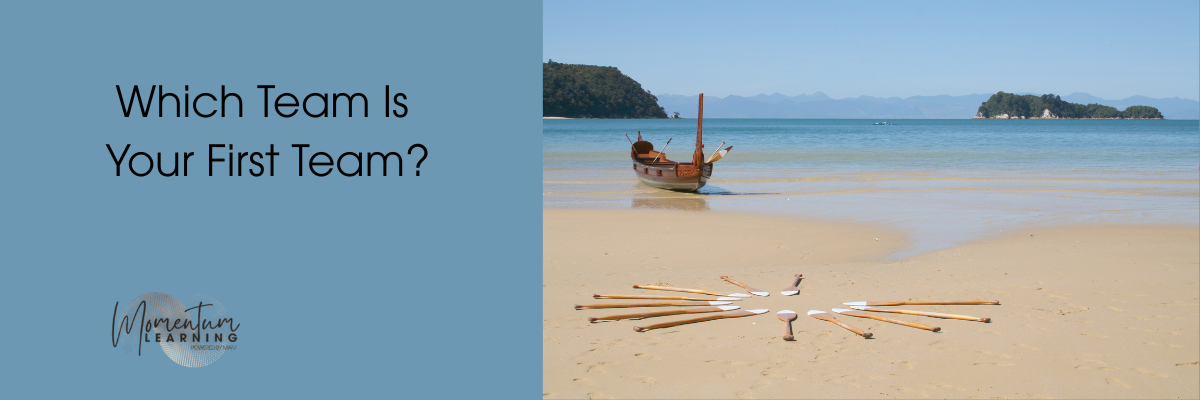
A waka doesn't move if everyone's paddling their own stroke. Doesn't matter how strong each paddler is on their own, if you're not calling together, counting together, the waka goes nowhere. Or worse, it goes in circles.
You've probably sat in the room version of that. A cross-team leadership meeting where everyone's technically in the waka together, but really still paddling for their own crew.
Their team. Their budget. Their priorities. All perfectly reasonable on their own, and all quietly working against the thing the room was actually convened to do.
You can usually spot it in the language. "That won't work for my team." "We can't commit to that timeline." Not wrong, necessarily. But said from a seat in the crew you lead, not from inside the crew that's meant to be paddling the whole waka together.
There's a name for this pattern, and it explains a lot about why cross-team meetings stall even when everyone in the room is capable and well-intentioned.
Patrick Lencioni calls this the First Team problem. Every leader sits in two waka: the crew they lead, and the wider crew of leaders they're part of. Whichever one you're actually paddling for shapes almost everything about whether the bigger waka moves as one.
It's easy to assume your strength only lives in the team you built, the one you can shape and direct. But the leadership table is where the decisions with the widest reach actually get made. Not the ones about a single team's patch, the ones that set direction for everyone. Prioritise that crew and you're paddling from the seat with the most leverage in the whole waka, the one place where alignment doesn't just help the room, it sets the course for everything downstream.
Lencioni's point is that if that crew at the table isn't paddling in time, it's not only the room that stalls. Everyone further down the waka feels it too. A leadership team out of sync doesn't just create noise around the table, it becomes the wobble the whole organisation moves with.
You've likely seen what that wobble actually looks like. Decisions made in the room quietly renegotiated the moment people are back with their own crews. Contradictory messages landing on the same staff member in the same week, because the people who sent them were never really paddling together. Energy spent managing the politics between teams instead of the work itself. Trust eroding slowly, not because anyone did anything dramatic, but because everyone could sense the crew at the front wasn't actually rowing as one.
The team you lead will always feel like your first crew. Whether the room full of fellow leaders gets paddled for the same way is usually a conversation with yourself before it's ever a conversation with them.
Because that's really what this comes down to. Before the conversation with the room, there's a quieter one worth having first, with yourself, about which crew you've actually been paddling for.
A few questions worth asking yourself before you call anything to the room:
Am I about to paddle for my patch, or actually paddle with this crew? Both have their place. Worth knowing which one you're doing before you speak, because they call for genuinely different things from you.
What would I call for here if I were counting for the whole waka, not just my own seat in it? Often a genuinely different answer than the first instinct, and usually the more useful one to bring into the room.
Where have I kept stroke for my own team this month, at some cost to the wider crew? Not a confession. Just useful information about where the balance currently sits, so you can choose it deliberately next time rather than by default.
None of this means your own crew matters less. It means the strength you're after doesn't only come from the team you lead. Some of it is sitting around that leadership table already, waiting on you to actually paddle for it.
Which crew have you been paddling for lately, and is that still the right call?
This is the mahi I do with leaders: the conversations that build genuinely high-performing teams, starting with the one around your own table. My calendar is open for 2027.