
Hold the seat and teach the balance
Hold the seat and teach the balance
"When I feel my tummy go funny, I do my breaths and it gets small again."
A Year 2 student at St Joseph's Catholic School in Paeroa said that. This was a child who had found transitions hard and often withdrew, or had big outbursts, during group activities. Nobody managed them into calm. Their teachers named emotions out loud, kept routines predictable, used visual supports and practised short co-regulation strategies every day, until the child could spot the signals in their own body and ask for help.
That's the whole idea in one small moment, and it's what Cognitive-Affective Learning (CAL) is built on.
A student can be well managed and still not be able to manage themselves.
The bike
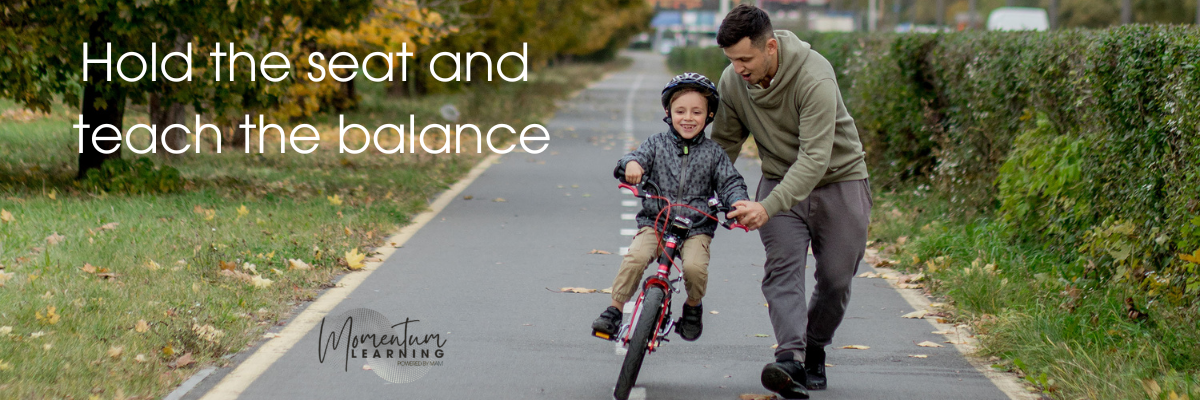
Most of us have taught a child to ride a bike. A hand on the seat keeps them upright, but it's only when we teach them to feel their own balance, and then let go, that they can ride alone.
When the classroom gets hard, most of us reach for the hand on the seat. We want calm rooms, safe playgrounds and teachers who aren't running on empty. Cognitive-Affective Learning is after the same calm, and it goes further, because it teaches the balance too. That's why I think it's the better answer to challenging behaviour.
Three reasons
It works on the cause. Ross Greene's line says it best: Kids do well if they can. When they aren't, a skill is missing or a problem is unsolved, and skills can be taught. Compliance can be managed from the outside, but self-belief has to be grown from within. The routines, visual supports and co-regulation in that Year 2 story also line up with what trauma-informed practice calls for, so this way of working is kind to the learners who find school hardest.
It's done with, not to. Managing behaviour leaves students and whānau in the audience. Cognitive-Affective Learning makes them partners. Russell Bishop and his colleagues found that dialogue-rich teaching was only observed in lessons where whanaungatanga was strong, and that's the thinking we build on.
It sits within how you already teach. Cognitive-Affective Learning isn't an extra to squeeze into a full timetable, and it isn't a separate lesson or a programme on the side. It sits within current teaching approaches and gives them a relational foundation to work from. At St Joseph's, teachers wove emotional and relational learning into literacy and maths, with character emotions in shared reading and perspective-taking in comprehension, and it dovetailed with the school's structured literacy professional learning. The refreshed New Zealand Curriculum (Te Mātaiaho, September 2026) points the same way. It names self-management and self-regulation as capabilities developed through everyday learning, not taught separately.
And we can show it
Here's our point of difference. Cognitive-Affective Learning lets us assess growth in the "soft skills", so it can be seen as well as felt, and whānau are part of how we do it. A triangulated approach brings together a standardised assessment for students from senior primary up, teacher observation and whānau voice, with alternative means for junior and middle primary that also draw on whānau voice. When the strands tell the same story, we can see a student's growth, and whānau help tell that story.
The research points the same way. Durlak and colleagues found an 11 percentile-point gain in achievement across 213 school-based programmes, and follow-up work found benefits still visible up to 18 years later. At St Joseph's Catholic School in Paeroa, Reading at or above expected went from 65% in 2021 to 94% in 2025, with Writing and Maths rising too, and the students' own words tell the same story.
Let's have a chat
I've pulled the thinking, the curriculum links and six questions to test any PLD into a white paper, Social-emotional PLD is the better answer to challenging behaviour. Sign up for the free St Joseph's case study on our Cognitive-Affective Learning page and you'll get the white paper as an extra.
If your school or cluster is weighing up PLD for behaviour, I'd love to talk about what Cognitive-Affective Learning could do for your students, teachers and whānau. Bring the classroom scenario your current approach doesn't touch, and we'll work out how to do it with the people at the centre.
Email me at mam@momentumlearning.ac.nz.
Ngā mihi,
Mary-Anne