

When Things Feel Quieter Than They Used To
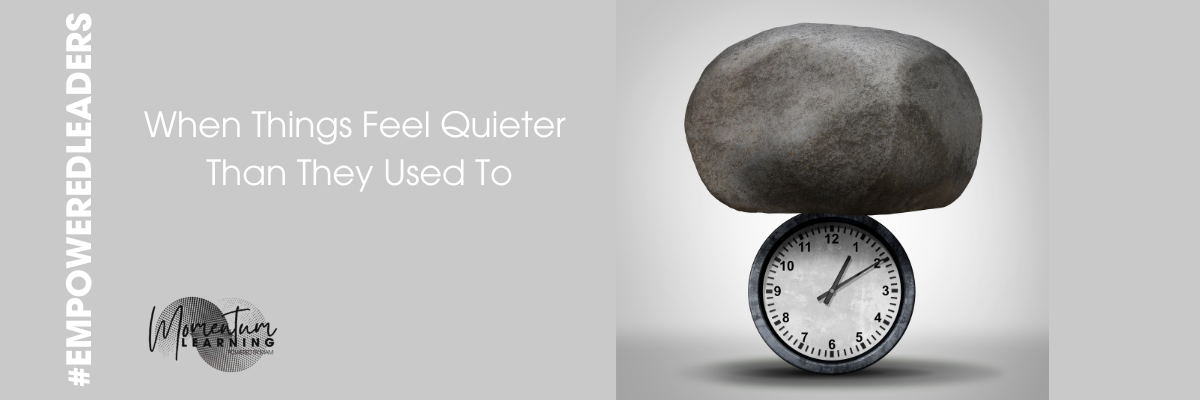
When Things Feel Quieter Than They Used To
There are moments in leadership where things just feel a bit… quieter.
You are still showing up.
Still doing the work.
Still carrying what needs to be carried.
But something has shifted.
The energy is not quite the same.
The certainty is not quite the same.
The edge you used to feel has softened.
And then the thinking starts.
Am I making a difference here?
Is this worth the energy I am putting in?
Do I still have what it takes to keep doing this?
This is the part of leadership that does not get talked about much.
Not because it is rare.
But because it is subtle.
When things feel quieter, it is easy to assume something is wrong.
But often, it is not a failure.
It is a signal.
A Simple Way to Work With It
When that shift shows up, keep it practical.
Notice it
Recognise that something has shifted.
No judgement. No overthinking. Just awareness.
Name it
Be clear about what is underneath.
Is it frustration from things not moving?
Fatigue from holding a lot for a long time?
Self doubt creeping in?
Naming it brings clarity.
Reconnect
Come back to what matters.
Why did this work matter to you in the first place?
What still matters, even now?
And then take one small step back in.
Not everything.
Just one move.
One idea.
One conversation.
One moment where you bring a bit more of yourself back.
The Reality
Momentum does not return all at once.
It rebuilds.
Quietly.
So if things have felt a bit quieter for you lately, take that as information.
Not that something is wrong.
But that something needs reconnecting.
Notice it.
Name it.
Reconnect.
And start there.
Arohanui
Mary-Anne 😊
Pressure and Perspective - Look for the Gold First

Look for the Gold First
Pressure has a reputation for sharpening thinking. Decisions come faster. Options reduce. Things feel clearer.
But there is something else happening beneath the surface.
Our brains are wired to notice problems first. It is part of our survival system. Neuroscientists describe this as the negativity bias. When the brain senses pressure, it scans quickly for risk, error, and threat. In leadership, that often shows up as a rapid search for what is wrong.
What needs fixing.
Where the gap is.
What isn’t working yet.
This instinct can be useful. It helps us identify issues quickly. But when pressure is high, it can also distort how we see people, performance, and progress.
When the brain is scanning for gaps, it often overlooks the gold that is already present.
Positive psychology offers a helpful counterbalance here. Researchers such as Martin Seligman and Barbara Fredrickson have shown that development accelerates when people build from strengths and existing success. When leaders begin by identifying what is working, they widen thinking, motivation increases, and new solutions become easier to see.
This is where the idea of mining the gold becomes powerful.
Before searching for gaps, we pause and look for:
• what is already working
• where progress is visible
• what strengths are present
• what capability already exists
In leadership conversations, this shift changes the entire dynamic. Instead of beginning with deficiency, we begin with possibility.
Neuro-linguistic programming (NLP) describes this as resource activation. When people recall moments of competence or success, the brain reactivates those emotional and cognitive states. Confidence rises. Thinking becomes more creative. Solutions become easier to generate.
In other words, when leaders start with the gold, the brain becomes more capable of addressing the gaps.
This does not mean ignoring problems. Leadership still requires honest reflection and improvement. But when development begins with strengths, gaps become areas for growth rather than evidence of failure.
Teams begin to think differently.
Instead of asking:
“What’s wrong here?”
The question becomes:
“Where is the gold, and how can we build from it?”
Under pressure, this matters even more. Pressure naturally narrows thinking toward risk and error. Leaders who intentionally look for strengths first help reopen perspective.
They notice capability before deficiency.
Progress before problems.
Possibility before limitation.
And from that place, development becomes both more human and more effective.
A moment to reflect
Where is the gold in my team right now?
What strengths might I be overlooking because I am scanning for gaps?
How might starting with the gold change the development conversation?
Go with clarity this week
Mary-Anne
The Leadership Question Most People Avoid

The Leadership Question Most People Avoid
The moment we decide someone else is the problem, we quietly step outside our own influence.
One of the most revealing signals in a strained relationship is a simple sentence:
“I don’t have a good relationship with them.”
It sounds like an observation.
But hidden inside that statement is a subtle shift.
The dynamic has been positioned entirely with the other person.
And when that happens, influence narrows.
The Leadership Reframe
In coaching and cognitive psychology, there is a powerful practice called reframing. It involves deliberately changing the lens through which we interpret a situation.
Instead of asking:
What is wrong with them?
A more useful question emerges:
How might I be relating in a way that is shaping this dynamic?
This is not about blame.
It is about returning to the one place influence always exists. Our own stance.
Because the moment we ask that question, the situation becomes something we can influence rather than something we simply observe.
Seeing the Dynamic
One of the most powerful shifts leaders make is learning to look at situations from more than one vantage point.
First, there is our own perspective.
What we notice. What we interpret. What we feel in the moment.
Second, there is the perspective of the other person.
How the interaction may be experienced on their side of the conversation.
But the most useful perspective is often a third one.
The ability to step back and see the interaction itself.
Not just the individuals involved, but the pattern unfolding between them. The signals, responses, and assumptions that shape the dynamic over time.
When leaders develop the capacity to see the interaction in this way, something shifts.
Attention moves away from judging the person and toward understanding the dynamic between people.
And dynamics can change.
When Language Limits Influence
Listen closely to how workplace dynamics are often described.
They are disengaged.
They push back on everything.
They avoid accountability.
These statements feel factual. Yet psychologically they position the problem outside the person describing it.
Research on locus of control, first described by psychologist Julian Rotter, shows that people who operate with an internal locus believe their actions influence outcomes. Those who operate with an external locus see outcomes as shaped primarily by others.
Leadership influence grows in the first position.
The Subtle Shift
This is what reframing looks like in practice.
“They push back on everything.”
Becomes: How do I respond when ideas are challenged?
“They seem disengaged.”
Becomes: How am I inviting participation?
“They avoid accountability.”
Becomes: How clear have I been about expectations?
“They shut down in conversations.”
Becomes: What signals might I be sending about psychological safety?
The shift is subtle, but significant.
Attention moves from judging behaviour to understanding the dynamic between people.
Where Leadership Influence Really Begins
Leadership is not simply about observing behaviour.
It is about shaping the conditions in which behaviour occurs.
Relationships at work are not static. They are ongoing interactions.
Every question, response, and tone shifts the dynamic.
Which means influence rarely begins by changing someone else.
It begins by changing the position from which we engage.
Next time you hear yourself thinking:
“I don’t have a good relationship with them.”
Pause.
And ask the question that reopens influence:
How might I be relating in a way that is shaping this dynamic?
Because the moment we shift perspective, we expand the space in which change becomes possible.
I’m curious to hear your thinking.
When relationships at work become difficult, what helps you step back into influence?
Go well this week
Mary-Anne
Leading Well Under Pressure - Pressure Is Not the Problem
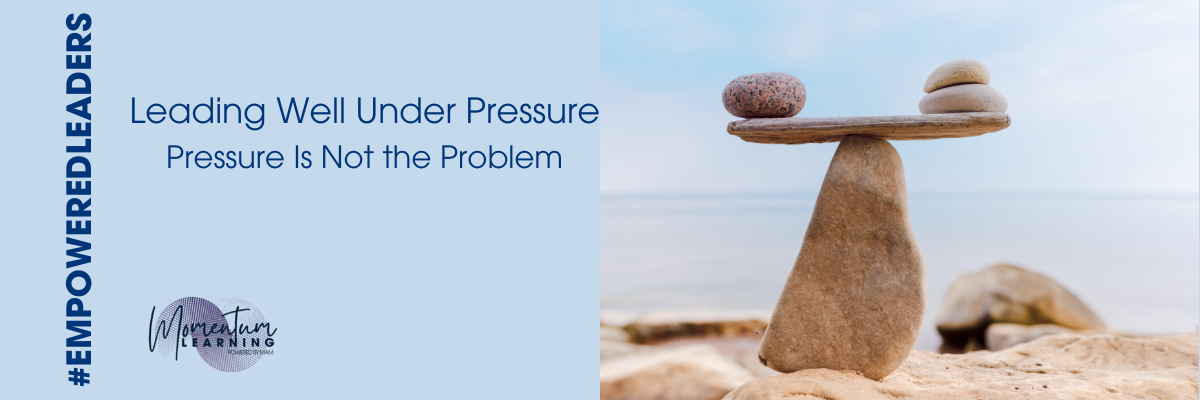
Pressure Is Not the Problem
I have been noticing something in the leaders I work with lately.
And if I am honest, in myself too.
Pressure does not always look like stress.
Sometimes it looks like busyness.
Sometimes it looks like delay.
Sometimes it looks like doing everything except the thing that really matters.
If you are leading right now, you are likely carrying more than most people see. Volume. Consequence. Ambiguity. Responsibility that does not switch off.
And under sustained pressure, behaviour shifts.
Not because you are incapable.
Because you are human.
And for some nervous systems, sustained cognitive load lands faster and more intensely.
Let us name what I see most often.
Overwhelm
When Clarity Feels Thinner
Overwhelm is not collapse.
It is saturation.
Too many inputs. Too many decisions. Too many variables competing for attention.
For leaders who process deeply, think laterally, or notice everything in the room, saturation can arrive quietly.
You are still delivering. Still leading. But clarity feels thinner.
You reread emails.
You lose the thread mid sentence.
You struggle to sequence priorities.
Psychologist Daniel Kahneman showed that under cognitive strain, the brain narrows its processing and defaults to faster, automatic thinking.
That narrowing is protective.
But leadership decisions often require integration. Nuance. Context. Relational awareness.
When the system is overloaded, integration becomes harder.
Not because you lack capability.
Because you are saturated.
Procrastination
When Task Initiation Feels Heavier Than It Should
There is usually one task sitting quietly at the edge of your awareness.
The conversation.
The decision.
The boundary.
You intend to do it.
But starting feels harder than it should.
Instead, you complete smaller, clearer tasks.
For some leaders, especially those whose brains are highly attuned to complexity or potential social impact, initiation difficulty is not avoidance. It is emotional load management.
If something carries uncertainty, visibility, or interpersonal risk, your system may stall.
Not out of laziness.
Out of protection.
Deflection
When You Stay Productive but Avoid the Core
This one is subtle and very common.
You remain productive. You are not disengaged.
But the work you choose is the work that feels structured, contained, and cognitively tidy.
Meanwhile, the emotionally complex issue waits.
Deflection can be a sign that your nervous system is seeking predictability.
When everything feels high stakes, your brain may gravitate toward tasks that offer closure and control.
That does not make you weak.
It means your system is trying to stabilise.
What This Really Means
None of these patterns mean you are not suited to leadership.
In fact, many leaders who think deeply, notice relational nuance, and carry responsibility carefully are more susceptible to saturation.
The very strengths that make you effective can also increase load.
The question is not, “Why can I not handle this?”
It is, “What does my nervous system need right now to think clearly?”
A Reflective Reset
If this resonates, pause with these:
Where am I saturated, cognitively, emotionally, or both?
Am I delaying because I do not care, or because it feels complex?
What would make this next step feel more structured or contained?
Who could help me break this into something clearer?
What small, defined action would move this forward today?
Not a full solution.
Just a defined start.
Pressure is part of leadership.
But different nervous systems process pressure differently.
When you understand how yours responds, and work with it instead of against it, something shifts.
Clarity becomes more accessible.
Energy becomes more directed.
Leadership feels less like force and more like alignment.
And if I can say this gently. If you are feeling stretched, circling, or slightly foggy right now, you are not alone in that.
I see it in strong leaders every week.
The work is not to push harder.
It is to pause honestly, name what is happening, and choose your next step with intention.
That is not weakness.
That is leadership.
Arohanui,
Mary-Anne
When the Joy Quietly Leaves - Depersonalisation and the Hidden Cost of Teaching.

When the Joy Quietly Leaves.
Depersonalisation and the Hidden Cost of Teaching.
Most teachers do not leave education because they stop caring.
They leave because caring becomes harder to sustain.
Across schools, I hear a version of the same sentence:
“I still love teaching. I just don’t feel the joy in it anymore.”
The change is rarely sudden.
It arrives quietly.
A little less patience.
A little less curiosity.
A growing emotional distance from work that once felt deeply meaningful.
Research describes this experience as depersonalisation, one of the central dimensions of teacher burnout. Depersonalisation occurs when educators begin to feel emotionally detached or develop cynical responses toward students and colleagues following prolonged exposure to stress and emotional demand (Maslach & Leiter, 2016; MDPI, 2024).
It is not indifference.
It is protection.
Teaching is relational work. Every day requires emotional presence, attention, judgement, and care. Increasingly, educators are supporting learners with complex behavioural needs, trauma histories, and diverse learning profiles.
The emotional load is real.
When demands remain consistently high and recovery remains low, psychological distance becomes an adaptive response. It allows educators to continue functioning even as emotional energy declines.
Many teachers do not recognise this shift when it begins.
They simply notice that the day feels heavier.
The tight stomach before the first bell.
The background anxiety that never quite settles.
Moving from lesson to lesson focused on getting through rather than connecting.
The treadmill accelerates.
Curriculum coverage.
Assessment expectations.
Supporting trauma affected learners.
Responding to increasingly neurodiverse classrooms.
Pastoral responsibility.
Documentation.
Meetings layered onto already full days.
There is always more to complete before the day ends.
Very little space to pause.
Even less space to recover.
And slowly, almost imperceptibly, attention shifts from presence to endurance.
Meaning quietly gives way to momentum.
Positive psychology research shows that wellbeing is sustained not simply through reduced stress, but through experiences of meaning, connection, and accomplishment (Seligman, 2011). When individuals lose a sense that their daily effort contributes to something worthwhile, emotional exhaustion increases even when performance remains high.
This is where many educators now find themselves.
Still capable.
Still committed.
But increasingly disconnected from the joy of their craft.
Research indicates that under sustained cognitive and emotional load, professionals rely more heavily on automatic decision making and emotional withdrawal as coping mechanisms (Kahneman, 2011; MDPI, 2024). Emotional engagement reduces not because teachers care less, but because psychological resources are depleted.
Depersonalisation is particularly concerning because it often masquerades as professionalism.
Emotional distance can look like efficiency.
Reduced engagement can look like resilience.
Detachment can feel necessary simply to keep going.
Teachers rarely leave because they cannot do the work.
They leave when the work no longer feels like who they are.
Education does not lose teachers only through workload.
It loses them when connection slowly gives way to endurance.
When presence is replaced by pace.
When meaning becomes harder to find inside an already full day.
Reclaiming joy in teaching is not about asking educators to give more.
It begins with recognising what prolonged pressure does to human connection.
Noticing the distance.
Naming the fatigue.
Creating conditions where teachers can once again experience moments of genuine engagement with learners.
Because the joy of teaching was never found in efficiency.
It lives in relationship.
In curiosity.
In the small moments where learning feels shared rather than managed.
Protecting those moments is not indulgent.
It is essential.
The future of education depends not only on retaining teachers, but on sustaining the humanity of teaching itself.
Where might depersonalisation be creeping into your workplace and heartspace?
A moment to reflect
When did teaching last feel joyful?
Where has pressure replaced connection?
What conditions would allow educators to experience their craft again, rather than simply endure it?
References
Kahneman, D. (2011). Thinking, Fast and Slow.
Maslach, C., & Leiter, M. P. (2016). Burnout in the workplace.
Seligman, M. E. P. (2011). Flourish.
MDPI (2024). Teacher Burnout and Organisational Factors in Education. https://www.mdpi.com/2076-3387/16/2/101
Go with Joy this week
Mary-Anne